What’s the Best Caravan Water Tank Monitor?
For most caravan, campervan, boat and 12V water tank setups, the best tank monitoring system is usually one that uses a pressure-based water level sensor.
That same principle can also work well for home rainwater tanks, sheds and off-grid properties, but this article is mainly focused on mobile water systems: caravans, campervans, boats and touring setups where reliability matters and space is limited.
That may sound like a bold answer, because there are plenty of other options: float switches, ultrasonic sensors, capacitive strips, Bluetooth tank gauges, inline flow meters and simple sight tubes. Some of them are cheap. Some of them are clever. Some of them are perfectly fine in the right situation.
But in a caravan or boat, the best tank monitor is not the one with the fanciest technology. It is the one that keeps giving you a reliable reading when the tank is dirty, the weather is hot, the water is moving, the pump is running, the van is parked on a slight angle, and nobody wants to crawl underneath to clean a stuck sensor.
That is where pressure-based tank sensing tends to win.
The short answer
A pressure-based water tank level sensor measures the weight of the water above the sensor. The deeper the water, the higher the pressure. From that pressure, the system can calculate the water level.
For caravan, campervan and boat use, that has several big advantages:
- There are no floats to jam.
- There are no impellers to clog.
- There is no ultrasonic beam that needs a clean, clear path to the water surface.
- It can give a high-resolution reading, not just “empty”, “half” or “full”.
- It works well in enclosed tanks.
- It suits 12V water systems, auxiliary tanks, grey water tanks, boat tanks and off-grid setups.
That does not mean pressure sensors are perfect in every situation. No sensor is. But in my opinion, for most practical caravan and 12V tank monitoring jobs, a good pressure-based system gives the best balance of reliability, accuracy, simplicity and real-world usefulness.
Why caravan tank sensors fail in the real world
The main problem with tank level sensors is not that they cannot work in a perfect test setup. Most of them can.
The problem is what happens after months or years in a real caravan, boat or campervan water system.
Mobile tanks are not clean laboratory containers. They can have sediment, biofilm, algae, scale, tank growth, water movement, pump vibration, awkward mounting positions, temperature changes and wiring exposed to moisture, dust and heat.
A sensor that looks good on paper can become annoying very quickly if it needs constant cleaning or loses connection when you actually need it.
Here are a few practical examples.
Example 1: The float that gets stuck
Float switches are simple and cheap. A float rises and falls with the water. That movement triggers a switch.
For very basic high-level or low-level alarms, they can be useful. The problem is that they are mechanical. Anything mechanical inside a tank can get stuck.
A float can jam against the tank wall. It can catch on wiring. It can be affected by slime, scale, grit or debris. In a caravan or boat, water movement can also make the reading less stable, especially when the vehicle is moving, parked unevenly or the tank is shallow and wide.
The result is simple: the monitor says the tank has water when it does not, or says it is empty when it is not.
For a pump protection system, that can be more than annoying. It can mean the pump runs dry or fails to run when it should.
Example 2: The little impeller that clogs
Some systems try to estimate water use with a small inline impeller or flow sensor.
These can be useful for measuring flow, but they are not really measuring tank level directly. They are trying to infer what is left by counting what has passed through the line.
That creates two problems.
First, the system needs to know the starting point. If the tank was not completely full when the counter was reset, the reading can be wrong from the beginning.
Second, small impellers can clog. In clean mains water that may be less of a problem, but in rainwater, grey water, caravan tanks, boat tanks or tanks that have been sitting for a while, small moving parts in the water path are not ideal.
In my experience, this is one of those things that sounds clever until the water is not perfectly clean.
Example 3: Ultrasonic sensors and dropouts
Ultrasonic tank sensors are popular because they are non-contact. They sit at the top of the tank and measure the distance down to the water surface.
That can be a good solution in some installations. But it depends heavily on the tank shape, mounting position and water surface conditions. Foam, condensation, turbulence, internal tank ribs, odd angles or obstructions can all make life harder for an ultrasonic sensor.
This can be especially relevant in caravans and boats, where tanks are often shallow, oddly shaped, mounted underneath the floor, or installed in locations that were never designed around a sensor.
There is also the communication side. Some Bluetooth ultrasonic tank sensors can drop out or become unreliable in practice. That is not necessarily a problem with the ultrasonic measurement itself, but for the user it feels like the same thing: the tank reading is not available when they want it.
For a fixed household tank, a well-installed ultrasonic sensor may be fine. For a caravan, boat or harsh outdoor 12V setup, I would be more cautious.
Example 4: Capacitive sensors and low resolution
Capacitive sensors detect level by measuring changes in capacitance. Some stick to the outside of a tank. Some are probes.
They can be neat, especially where you do not want to penetrate the tank. But for practical caravan and boat use, they can be limited by tank material, wall thickness, mounting, calibration and resolution.
In my opinion, many capacitive options are better suited to simple level indication than accurate tank monitoring. They can tell you roughly where the water is, but they are not usually my first choice if the goal is a proper, useful percentage or litre reading.
Why pressure-based sensing is usually the best choice
A pressure sensor is simple in the way that matters.
It measures the pressure created by the water above it. More water means more pressure. Less water means less pressure.
There are no moving parts inside the tank doing the measuring. That is the major advantage.
Even if there is some growth or contamination inside the tank, a properly selected pressure sensor will usually keep working because it is not relying on a float moving freely or a tiny impeller spinning. There can still be installation considerations, but the basic sensing method is robust.
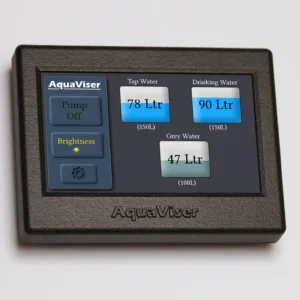
Pressure sensors can also provide very high resolution when paired with the right electronics. Instead of four rough bars on a display, you can get a much more useful reading: percentage full, litres remaining, or a calibrated tank level — like on the AquaViser range found at www.aquaviser.com.au
aquaviser 4.3″ touchscreen
For everyday touring, that matters. “About half full” is not the same as knowing you have enough water for two more showers, another night off-grid, a weekend away, or the next leg of a remote trip.
What to look for when choosing a caravan tank monitor
For caravan, campervan and boat use, I would judge a tank monitoring system by these criteria.
1. Reliability
Reliability comes first. A tank sensor that works beautifully for two weeks and then needs cleaning is not a good caravan tank monitor.
Look for something with minimal moving parts, sensible wiring, a stable reading and an installation method that suits the tank.
2. Accuracy and resolution
Accuracy is not just about showing a pretty percentage on a screen. It is about whether the number is useful.
A sensor that only gives rough steps may be fine for “empty / half / full”. But if you want to manage water carefully in a caravan, boat or off-grid setup, higher resolution is much more useful.
3. No moving parts
This is a big one. Moving parts are often where tank sensors become unreliable.
Floats can stick. Impellers can clog. Mechanical parts can wear, jam or become affected by debris.
For that reason, I prefer pressure-based sensing for most caravan and boat tank monitoring applications.
4. Easy installation
The best sensor is not much help if it is painful to install.
For caravan and campervan owners, the system should be practical. It should suit existing tanks, 12V systems, fresh water tanks, grey water tanks, auxiliary tanks and boat tanks without requiring industrial instrumentation knowledge.
5. 12V compatibility
Most caravan, campervan and boat water systems are 12V systems.
A tank monitor designed around 12V use is usually a better fit than trying to adapt something intended for industrial control panels, mains-powered buildings or generic home automation.
6. A visible, useful display
Phone apps are fine as an extra feature, but a caravan tank monitor should not depend entirely on a phone.
A clear local display is often better. You walk past it, glance at it, and know what is going on. That is especially useful in a caravan, boat or campervan where water is part of daily management.
7. Pump integration
A tank monitor becomes much more useful when it can work alongside the pump system.
At minimum, it should help you understand what is happening with your water supply. Ideally, the system should make it easy to see tank level and pump status together, because that is how people actually use water systems.
8. Weather and heat resistance
This is especially important in Australia.
Electronics installed in caravans, boats, service compartments, under-seat cavities, sheds or outdoor areas can experience brutal heat. A product designed for mild indoor conditions may not last in a hot van or enclosed compartment.
The case material, mounting, wiring, connectors and display all need to be selected with the environment in mind.
9. Tank shape and calibration
A good system should not assume every tank is a perfect rectangle.
Caravan and boat tanks are often awkward shapes. They can be shallow, wide, curved, baffled, sloped or mounted in tight underfloor spaces. Calibration needs to suit the actual tank, not an imaginary one.
10. Price versus annoyance
The cheapest sensor is not always the cheapest solution.
If a cheap sensor fails, gives bad readings or needs repeated cleaning, it costs time and frustration. For caravan and boat water systems, reliability is worth paying for because the monitor is there to prevent inconvenience when you are away from home.
So, which caravan tank sensor type is best?
Here is the practical ranking.
Best overall: pressure-based sensor
For most caravan, campervan, boat and off-grid 12V water tank setups, I would choose pressure-based sensing.
It is accurate, high-resolution, reliable, has no moving measuring parts and suits enclosed tanks well. It is especially strong when paired with a proper display and calibration system. Like the AquaViser System:
Best cheap basic option: float switch
A float switch can be fine for a simple alarm or pump cut-off. It is not my favourite for accurate tank monitoring, but it can be useful when you only need one or two fixed points.
Use it where “low water” or “tank full” is enough.
Best non-contact option: ultrasonic
Ultrasonic sensors can be good when mounted correctly in a suitable tank. They are attractive because they do not touch the water.
But I would be careful using them in tanks with condensation, foam, turbulence, awkward geometry or unreliable wireless communication.
Best for simple indication only: capacitive
Capacitive sensors can be useful where you want something non-invasive or simple. But for accurate, reliable, high-resolution monitoring across many caravan and boat tank types, I would not put them ahead of pressure-based sensing.
Use with caution: impeller or flow-based systems
Flow meters are useful for measuring water usage, but they are not the same as direct tank level sensors. They can clog, drift from reality if not reset correctly, and give misleading remaining-volume estimates.
Where AquaViser fits in
AquaViser has been developed in Australia to solve the exact problems that show up in real caravan, campervan, boat and 12V water systems.
The goal is not just to display a tank level. The goal is to make tank monitoring practical for caravans, campervans, boats, off-grid properties and 12V water systems where reliability actually matters at an affordable price.
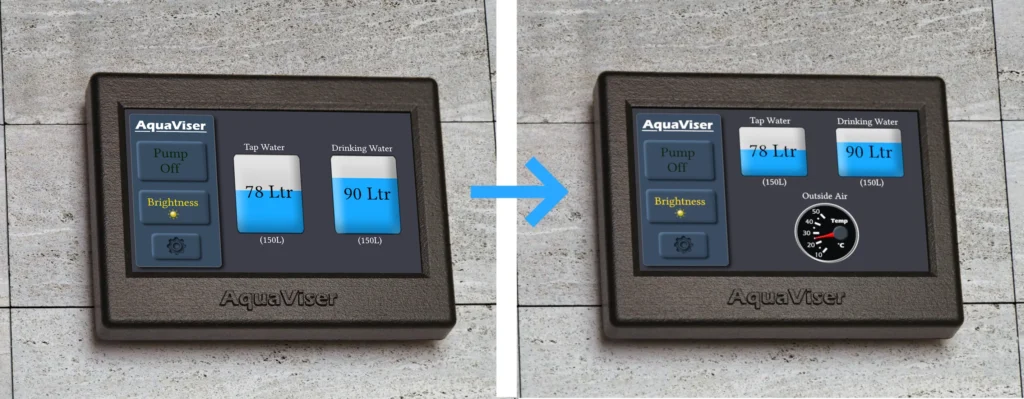
At the time of writing, AquaViser has a bundle with everything needed for a single tank setup. For multiple tanks, you can also buy up to three sensors for the module. The system also supports a temperature sensor, with three different probe types to choose from. Check out the online store for more information.
An example setup with two tanks and a temperature probe using one of the channels.
AquaViser uses pressure-based tank sensing because, in our experience, it is the best fit for real-world caravan and boat tanks. It avoids the common problems of stuck floats, clogged little impellers, rough low-resolution readings and sensor systems that are not designed for harsh installations.
The equipment has also been designed around Australian conditions. That includes the enclosure itself. AquaViser uses a nylon case to better handle the kind of heat that can occur in Australian caravans, boats, sheds and outdoor installations.
That matters because a caravan tank monitor is not usually installed in a comfortable office. It may be in a hot van, a service compartment, near pumps, wiring and plumbing, or somewhere that gets exposed to vibration and temperature swings.
AquaViser is built around the idea that a caravan tank monitor should be accurate, clear, tough and easy to live with.
Final verdict
For most caravan, campervan, boat and 12V water tank setups, the best tank monitoring system is one that uses a pressure-based sensor.
Floats are cheap, but they can stick. Impellers can clog. Ultrasonic sensors can work well, but the installation has to be right and the signal path matters. Capacitive sensors can be useful, but often lack the resolution and consistency people want from a proper tank monitor.
A good pressure-based system gives you the most practical balance: no moving measuring parts, high resolution, strong reliability and suitability for the kinds of tanks people actually use in caravans, campervans, boats and off-grid setups.
The best sensor is not the one that sounds most advanced. It is the one that keeps working when the tank is dirty, the weather is hot, the pump is running, the van is parked slightly off level and you just want to know how much water you have left.
That is why, for most people, pressure-based caravan tank monitoring is the best place to start.